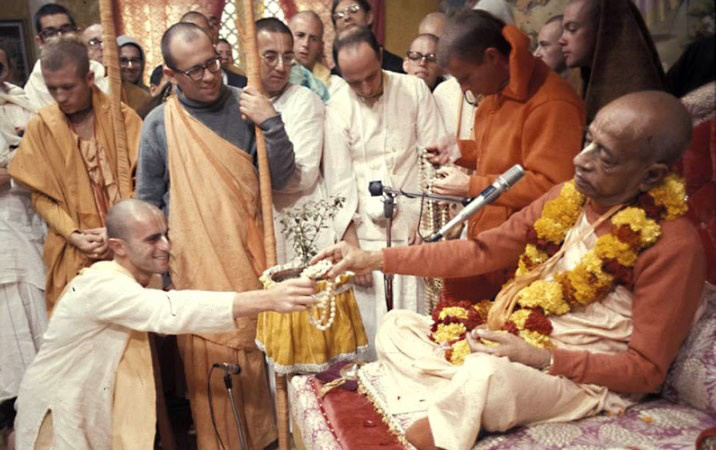
Contributed by Vidura Mahatma Dasa In order to attain the highest perfection of life one must approach a bona fide spiritual master coming in the disciplic succession from Lord Krishna Himself. The self-realized spiritual master is able to present the real conclusions of Krishna’s instructions in a way that can be understood and executed as applicable to this day and age. This is the special purpose and great need of accepting a bona fide spiritual master. The rare opportunity to approach a bona fide, self- realized spiritual master coming in the authorized chain of disciplic succession is available to everyone today and is indeed intended for everyone [in every town and village] to take advantage of, owing to the mercy of Sri Krishna Chaitanya Mahaprabhu and His Divine Grace Srila A.C. Bhaktivedanta Swami Prabhupada. Readers will find this composition instrumental in ascertaining the philosophical basis of taking shelter of Srila Prabhupada – the current approachable link in the disciplic succession – by adhering to the principles and instructions given in his books. The execution of Srila Prabhupada’s discipline will surely elevate one to the perfectional stage of life leading back home, back to Godhead.
Approaching a bona fide spiritual master for spiritual understanding “Just try to learn the truth by approaching a spiritual master. Inquire from him submissively and render service unto him. The self-realized soul can impart knowledge unto you because he has seen the truth.” Bhagavad Gita 4.34 Purport by Srila Prabhupada The path of spiritual realization is undoubtedly difficult. The Lord therefore advises us to approach a bona fide spiritual master in the line of disciplic succession from the Lord Himself.
No one can be a bona fide spiritual master without following this principle of disciplic succession. The Lord is the original spiritual master, and a person in the disciplic succession can convey the message of the Lord as it is to his disciple. No one can be spiritually realized by manufacturing his own process, as is the fashion of the foolish pretenders. The Bhāgavatam
says: dharmaṁ hi sakshad-bhagavat-pranitam—the path of religion is directly enunciated by the Lord. Therefore, mental speculation or dry arguments cannot help one progress in spiritual life.
One has to approach a bona fide spiritual master to receive the knowledge. Such a spiritual master should be accepted in full surrender, and one should serve the spiritual master like a menial servant, without false prestige. Satisfaction of the self-realized spiritual master is the secret of advancement in spiritual life. Inquiries and submission constitute the proper combination for spiritual understanding.
Unless there is submission and service, inquiries from the learned spiritual master will not be effective. One must be able to pass the test of the spiritual master, and when he sees the genuine desire of the disciple, he automatically blesses the disciple with genuine spiritual understanding. In this verse, both blind following and absurd inquiries are condemned. One should not only hear submissively from the spiritual master; but one must also get a clear understanding from him, in submission and service and inquiries. A bona fide spiritual master is by nature very kind toward the disciple. Therefore when the student is submissive and is always ready to render service, the reciprocation of knowledge and inquiries becomes perfect.
Note: All book citations in this article have been taken from Srila Prabhupada’s original, unedited and unrevised editions (pre-1978). Author’s emphasis added.
This verse and purport serves as a clear outline of the process of receiving transcendental knowledge from a bona fide spiritual master. One must first approach a self-realized spiritual master in order to receive genuine spiritual understanding from him and thereby make real progress in spiritual life. The idea is that both the spiritual master and the disciple must be genuine. One must pass the test of the spiritual master, entailing submission, service and inquiry. The spiritual master then automatically blesses the disciple with genuine spiritual understanding. This spiritual understanding is not a one time result from passing a test but a continual, reciprocal process dependent on the faithful execution of the spiritual master’s instructions: “Diksa is the process by which one can awaken his transcendental knowledge and vanquish all reactions caused by sinful activity.” (C.c. Madhya, 15.108, purport) ________________________________________ “Diksa actually means initiating a disciple with transcendental knowledge by which he becomes freed from all material contamination.” (C.c. Madhya, 4.111, purport) ________________________________________ “Initiation means receiving the pure knowledge of spiritual consciousness.” (C.c.
Madhya, 9.61, purport) ________________________________________ “The disciple and Spiritual Master are never separated because the Spiritual Master always keeps company with the disciple as long as the disciple follows strictly the instructions of the Spiritual Master.” (S.B. 4:28:47, purport) Srila Prabhupada’s Testing The disciple must pass the test of the spiritual master. Srila Prabhupada outlines his test for every member of the Krishna consciousness movement very clearly in his books. This test determines whether a prospective disciple is fit for initiation into genuine spiritual understanding.
“In our Krsna consciousness movement, the requirement is that one must be prepared to give up the four pillars of sinful life: illicit sex, meat eating, intoxication and gambling. In Western countries especially, we first observe whether a potential disciple is prepared to follow the regulative principles. Then he is given the name of a Vaisnava servant and initiated to chant the Hare Krsna maha-mantra, at least sixteen rounds daily. In this way the disciple renders devotional service under the guidance of the spiritual master or his representative for at least six months to a year. He is then recommended for a second initiation, during which a sacred thread is offered and the disciple is accepted as a bona fide brahmana.” (Cc Madhya-lila 24:330, purport) ________________________________________ “Thus in the beginning the students of our Krsna consciousness movement agree to live with devotees, and gradually, having given up four prohibited activities illicit sex, gambling, meat-eating and intoxication they become advanced in the activities of spiritual life. When one is found to be regularly following these principles, he is given the first initiation (hari-nama), and he regularly chants at least sixteen rounds a day. Then, after six months or a year, he is initiated for the second time and given the sacred thread with the regular sacrifice and ritual.” (Cc Adi-lila 17:265, purport) ________________________________________ “Due to the necessity of these activities, we do not immediately initiate disciples in the International Society for Krishna Consciousness. For six months, a candidate for initiation must first attend arati and classes in the sastras, practice the regulative principles and associate with other devotees. When one is actually advanced in the purascarya-vidhi, he is recommended by the local temple president for initiation. It is not that anyone can be suddenly initiated without meeting the requirements. When one is further advanced by chanting the Hare Krsna mantra sixteen rounds daily, following the regulative principles and attending classes, he receives the sacred thread (brahminical recognition) after the second six months.” (Cc Madhya-lila 15:108, purport) ________________________________________ “We accept many people into our Society as duly initiated disciples, but only if they vow to observe these regulations: no more illicit sex, no more gambling, no more intoxication, and no more animal-killing or meat-eating.” (A Second Chance – 16) Time, place and circumstance Within a world-wide institution of temples and thousands of members/disciples, Srila Prabhupada satisfied the principle of testing between spiritual master and disciple through representatives of his (e.g., temple presidents). Formal initiation depended on one’s following the rules and regulations, which was observed by temple authorities and then the devotee recommended for initiation to Srila Prabhupada. By 1977 Srila Prabhupada gave representatives full discretionary rights to decide whether a new devotee should be given initiation (Room Conversation—7/19/77, Vrndavana). Such practical adjustments are common in the preaching activities of great acharya’s, keeping in line with the essence of the principles of devotional service in accordance with time, place and circumstance: “So acharya means, just like Gosvamis, they would read all the scriptures and take the essence of it and give it to his disciples that, “You act like this.” Because he knows what to give, how to
manipulate, so that his ekantatah shreyas will be achieved. Ultimate goal.
Therefore the acharya knows how to adjust things, at the same time keep pace with the spiritual interest. That is acharya. It is not that the same thing to be applied everywhere. He is eager to engage actually the people in the real benefit of life, but the means may be different. Just like my Guru Maharaja. He is the first time that he allowed the sannyasis to drive in a motorcar. This is adjustment. The acharya knows how to adjust things. The real purpose is how one will take to spiritual consciousness, or Krishna consciousness. Keeping one’s aim to that point some concession may be given. As far as possible, keeping pace with the time, circumstances.” (Srimad-Bhagavatam Lecture 1.1.9 — Auckland, February 20, 1973) ________________________________________ “Srimad Viraraghava Acarya, an acarya in the disciplic succession of the Ramanuja- sampradaya, has remarked in his commentary that candalas, or conditioned souls who are born in lower than sudra families, can also be initiated according to circumstances. The formalities may be slightly changed here and there to make them Vaisnavas.” (SB 4.8.5 purport) ________________________________________ “Vaisnava who is preaching, it may be in a different way, according to time and place and the party–they have to change something, desa-kala-patra–but we have to see the essence.” (SB Lec. 10/18/74) ________________________________________ “All the students of the Krishna consciousness movement have undergone the regular process of initiation.” (Adi 17.265 purport) To be continued……