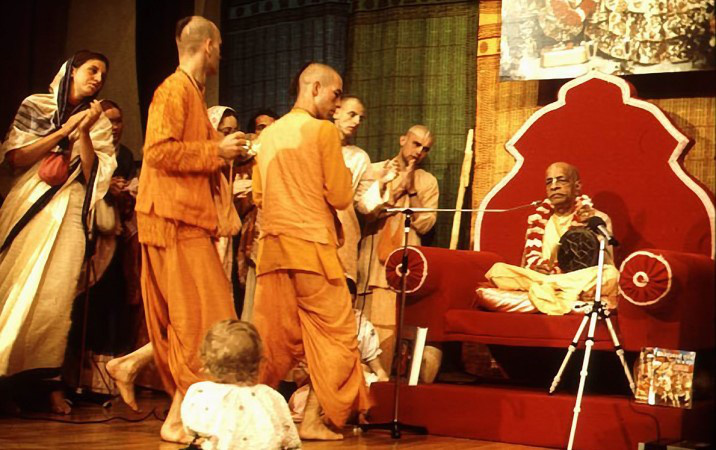
What about the actual meaning of the song (Gurvastakam)…? Does it only apply to a particular type of devotee or spiritual master?
A good question but not the kind of questions we are seeing from the New Dwarka community or any other ISKCON centre for that matter.
Yes, the samsara-dava prayers definitely do apply to a very particular type of devotee or spiritual master: "This song is offering obeisances particularly to the spiritual master, and the symptoms of the spiritual master are described in this prayer. The spiritual master has two kinds of symptoms in his activities. One kind is called constant, and other kind is called temporary. So the first verse says that the constant symptom of the spiritual master is that he can deliver his disciples from the blazing fire of this material existence. That is the eternal qualification of spiritual master. Tranaya means for deliverance, and karunya means compassionate, very merciful. The spiritual master comes to the deliverance of the fallen souls out of his causeless mercy. Nobody has any business for the sufferings of others. The best example is Lord Jesus Christ, that he suffered for others. And it is the principle in the Bible that he accepted all the sins of others. This is the sign of spiritual master, that he voluntarily accepts the sinful activities of others and delivers them. That is the qualification of spiritual master. How it is? Just like ghanaghanatvam. Ghanaghanatvam means dense cloud in the sky. The first example has been said, that this material existence is just like forest blazing fire. Now, to extinguish the forest blazing fire, there is no use of sending fire brigade. The fire brigade cannot approach the forest fire; neither any man can go there to extinguish the fire. One has to depend completely on the mercy of nature. That means one has to completely depend on the cloud in the sky. Otherwise, there is no question of pouring water on that blazing fire. So the example is very appropriate. As man-made engine or fire brigade is unable to extinguish
the forest blazing fire, similarly, the material existential blazing fire cannot be extinguished by any man-made method." – Purport to Sri-Sri-Gurv-astakam – Los Angeles, January 2, 1969 "So guru means spiritual master means who can deliver one from this forest fire. Just like when there is forest fire, the animals are very much disturbed, and they die mostly. The snakes, they die immediately. So this forest fire, samsara-davanala, is going on perpetually, and the person or the authorized person who can deliver you from this forest fire of material existence, he's called guru, or the spiritual master. Samsara-davanala-lidha-loka-tranaya karunya- ghanaghanatvam. […] Just like cloud takes the water from the sea – cloud hasn't got its own water; cloud takes water from the sea – similarly, a spiritual master brings mercy from the Supreme Personality of Godhead. Just see the comparison. He has no own mercy, but he carries the mercy of the Supreme Personality of Godhead. That is the qualification of spiritual master." – Lecture on Gurvastakam at Upsala University – Stockholm, September 9, 1973 The Gurvastakam is meant for: Spiritual master who can actually deliver his disciples.
Spiritual master who is directly receiving the mercy of Lord Krishna.
Spiritual master who is authorized.
Spiritual master in the same category of Lord Jesus Christ (a saktyavesa avatara) (To be continued…)