“Simply by remembering your Guru Maharaja, he is present with you”
Rukmini was 16 years old when she first met Srila Prabhupada, whose first words to her were, “Where are your parents?” When I was initiated, Prabhupada beautifully encouraged me.
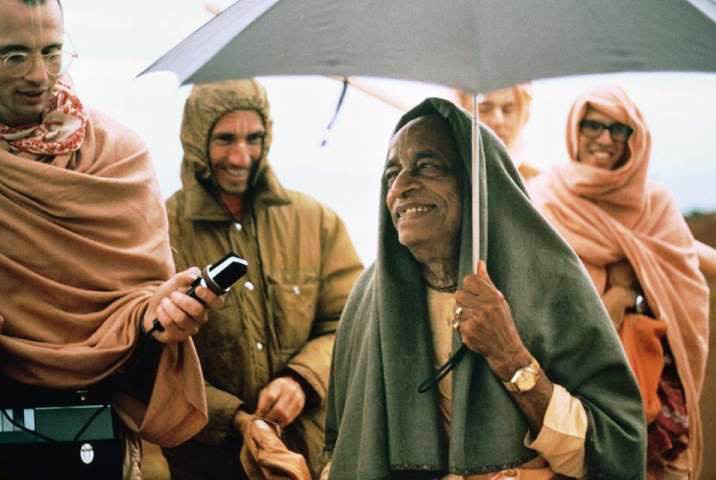
Bonds of Love: Rukmini Devi Dasi Rukmini was 16 years old when she first met Srila Prabhupada, whose first words to her were, “Where are your parents?” When I was initiated, Prabhupada beautifully encouraged me. Maybe I reminded him of Rukmini, because he told the story of Rukmini and then said to me, “You are a beautiful girl and now become more beautiful within also.” Those words were such a profound, life-long instruction. Prabhupada also said, “Krishna can accept any number of beautiful girls. Your name is Rukmini, and some day Krishna will kidnap you.” Prabhupada saw me in some far-distant perfected stage and encouraged me to take the steps I needed to take to get there. He had faith in his disciples and was patient with us.
Once, in 1968, when Prabhupada was in his quarters at 26 Second Avenue in New York, he looked at every single devotee directly and deliberately, then said, “I want each one of you to open a temple somewhere.” I was only 16, and I said, impetuously, ”Even the girls, Swamiji?” Prabhupada said, “Yes there is no difference between the boys and the girls when you are preaching Krishna consciousness.” That was a thrilling and important instruction.
Once my parents came to the Sunday feast in New York when the temple room was so crowded that by the force of the crowd they had to bow down with everyone else. Afterwards I told Prabhupada about it, and he said, “Yes this is the goal of our Krishna consciousness movement: just get them to bow down before Krishna.” The next year, 1969, we came to New York from Montreal and Prabhupada thought I looked thin and that I didn’t look happy or healthy. At that time Prabhupada said that my husband and I should live separately. It was shocking, but on his order I stayed in New York working with the altar and the Deities and my husband went back to Boston, where he was painting. Then I asked Brahmananda, the New York temple president, if I could go to Los Angles to learn Deity worship from Silavati. He agreed, so I was in Los Angeles for about a year learning Deity
worship; it was wonderful.
During this period, my husband was with Prabhupada and was trying to explain himself to Prabhupada, but Prabhupada kept ignoring him. Finally Prabhupada looked directly at my husband and said, “I have given you my daughter and you have not taken care,” and then looked away.
After that Prabhupada was gone for a long time to London and Germany. When he returned to Boston he asked my husband, “Where is your wife?” My husband said, “You sent her away Prabhupada.” Prabhupada smiled and my husband said, “Should I send for her?” Prabhupada said “Yes. Husband without the wife is only half; wife without the husband is only half.” So I was supposed to go to Boston, but Prabhupada was coming to Los Angeles and I would miss his darshan. I felt sad that I wouldn’t see him, so I made a big tray of besan laddus.
Prabhupada had told us, “If you can learn to make laddus and kachoris, I will bless you. I only want to go to Krishnaloka to get Krishna’s laddus and kachoris.” So I made this big batch of laddus, wrote a little note to Prabhupada, and asked the devotees in Los Angeles to give it to him.I’d been in Boston for a week or so when Upendra, Prabhupada’s servant, called and said that Prabhupada had liked the laddus and wanted me to make some for him every fortnight and send them to him.
So I started making and sending laddus to Prabhupada every fourteen days. Each time I would also send a little letter and a prayer, and each time Prabhupada would reply with a sweet and grateful letter back to me. These were the days when we were prohibited from writing letters to Prabhupada, because we were bothering him, though, so I began to think I should just send the laddus without the letter. The next box I sent I didn’t enclose a letter. Then at the bottom of a letter Prabhupada wrote to Chandanacharya at the Boston temple he wrote, “I have received a box of laddus from Boston and I think they are from Rukmini Devi, so please thank her and give her my blessings.” That was a great and sweet lesson about service in separation. I didn’t get to see Prabhupada personally at that time, but it was more meaningful to do that service, and I received more reciprocation than if I had been there.
In Los Angeles I’d learned Deity worship from Silavati, who had a beautiful standard. I tried to introduce the things I had learned to the Boston devotees, but they said, “That may be the way they do things in Los Angeles, but we are not really interested in what you have to say. This is the way we do things here in Boston.” After that I had a dream that the Radha-Krishna Deities were on the altar. The curtains closed and then opened and the Deities were gone! Everyone was lying on the floor in the temple and saying, “This is how they do things here,” and no one was doing anything. In the dream I was distraught and went to Prabhupada and said, “I think it’s my negligence that the Deities disappeared.” Later, in my disturbed state, I wrote to Prabhupada, saying, “I heard that you said that Deity worship without bhava is idol worship.” Because of my negligence I felt the Deities had disappeared and we were worshiping idols. Prabhupada replied with a beautiful letter in which he gave a long list of points about cleanliness, like showering daily, cleaning this and that, clipping your nails. He said do all that and then the bhava will come; never be negligent but
always be careful, and then the bhava will come.
I was young and sentimental, and once I said to Prabhupada, “I feel so far away from you when you’re not here.” Whenever Prabhupada was in the room I felt Krishna conscious, and when he wasn’t I fell back into my usual mundane consciousness.
Prabhupada replied, “You should never feel separated from your Guru Maharaja. Simply by remembering your Guru Maharaja, he is present with you.” He told me about how Arjuna lost all his strength when he forgot Krishna and how, when he again remembered Him, he was empowered. That was a beautiful instruction Prabhupada gave me in Montreal.
At that time Jayapataka Maharaja was a brahmachari in Montreal, and he used to chant his japa so loudly that he disturbed everyone. Prabhupada told him he should chant on the mountainside near the temple, where he could chant as loudly as he wanted. Prabhupada had a way of pleasing everyone, of making all parties satisfied.
Once when my husband and I were going to see Prabhupada in his room in Los Angeles, Prabhupada saw my husband first and asked, “Where is Rukmini?” My husband didn’t realize I was behind him and said, “Oh, she is always busy doing something.” Then Prabhupada saw me and said, “Yes always be busy, busy, busy otherwise Maya will say ‘Come and play with me,’” and Prabhupada made a gesture as if he was Maya embracing someone.
Prabhupada would say something and then years later reference it again, and then few years later reference it once more, making the various conversations part of an ongoing story. I wasn’t a good painter, but in Boston I was painting anyway. When Prabhupada saw both my painting and my husband’s painting he said, “The husband is better,” and it was true. A few years later in Mayapur, he looked at the Bengali clay dolls my husband and I had made and said, “The wife’s is better,” and it too was true.
About the doll-making, Prabhupada said, “The more you do it, the more your expertise will develop,” and he wanted us to learn from the best craftsman in Bengal. Like his Guru Maharaja, Prabhupada wanted multimedia presentations.
Sometimes I think about how an ordinary, elderly, aristocratic gentleman from India would have seen the way we Westerners behaved, the way we wore saris and dhotis, the way we ate, the way we cooked, and even the way we spoke to each other, and he would have found it abhorrent. One of Prabhupada’s godbrothers said about himself, “I did not have the temperament to associate with such low-class people.” It was entirely Prabhupada’s transcendental temperament and his extraordinary mercy that he could embrace us and pull us step by step closer to becoming something like Vaishnavas.
Sometimes Prabhupada would be aggressive in his communication if he felt that was the best way to get through to someone – to wake someone up. If a milder form of communication was more appropriate for someone else, then he used that. There was never one way he did things.
In his wisdom and the way he responded to people and situations, he was never stereotyped.
At one of the Delhi pandals the VIP guests would be ushered into a small room at the side of the pandal where I would greet them and help get them seated. Then Prabhupada would sit and speak with them before he went on stage.
One of Prabhupada’s most astounding spiritual qualities was the way he could see the heart.
Someone would seem to me to be pious, but Prabhupada could see that person’s mentality. He
would answer the same question two or three different ways depending on the mentality of the person asking it.
Once, an elderly, seemingly distinguished and saintly gentleman said, “Swamiji, give us your mercy. Please give us your mercy!” With what appeared to be disgust Prabhupada replied, “I already gave everything, but still you do not take.” And then he said, “It is just like a man who has fallen into well and is crying for help – the rope is there but he does not take it.” His words were so strong.
Once, Prabhupada was walking around the Chanakyapuri neighborhood in Delhi. I was walking with him, along with a few other devotees. He was pounding his cane into the sidewalk and quoting a verse from Bhagavad-gita: Urdhvam gacchanti sattva-stha and jaghanya-guna-vrtti- stha – those who are in the mode of ignorance go down. Here he was, walking through this small, aristocratic neighborhood in Delhi and being so fierce, pounding his cane.
It was almost as if he was expressing a fierce compassion for these aristocratic people who were going down. We too had been “going down” into the depths of ignorance no matter what kind of middle or upper middle class American life we might have come from. If we hadn’t met Prabhupada we would be just an unfortunate statistic of some sort.
I am still hoping to be transformed into something more pleasing. Prabhupada opened the door for us to loving Krishna. Krishna becomes the possession of someone who loves Him, so to open the door to that Vrindavan mood where Krishna becomes purchased by His devotee… how can we measure the value of what Prabhupada gave us? If we could only take it. He has given us everything. Now it is up to us to take it.
In his last days, Prabhupada said, “Everything is moving and acting under the supreme direction of Krishna. This consciousness is Krishna consciousness.” So this knowledge is his gift – to walk through the world in this consciousness. That’s where we are supposed to be, but now there is a gap between knowing the goal and trying to approach the goal. Sometimes we take a step back and don’t try hard enough. When we fall short, we have to pray for strength from Prabhupada, Lord Chaitanya, and Krishna: I’m so small. I need your strength to carry me.
It’s interesting that so many people who fall down come back and try again. The way he affected people is just so extraordinary. Just the way he impacted people indicates that he’s a divine being.
Prabhupada said his disciples were not afraid enough of maya. As we get older, we have to be careful not to become lax and compromised and influenced by this postmodern world into thinking that everything is of equal value.
On another topic, my husband was an artist – a wonderful painter who did a lot of paintings for Prabhupada’s books. So Prabhupada sent us to India to make clay dolls. My husband saw himself as a fine artist, and Prabhupada sent him to India to be a craftsman.
Around that time and before our son Gaura was born, my husband asked Prabhupada, “If I ever have a son, should I train him to do my work?” It was almost like a caste-conscious kind of question. Prabhupada said, “You are not a potter.” He used what sounded like a denigrating term for the art we were doing. “You are not a potter. Tomorrow you may be called to worship the Deities.” It was such a beautiful instruction – that our “work” is not some kind of caste. We shouldn’t be attached to the work itself but to serving Krishna. Today we may be doing one thing
and tomorrow we may be asked to do something else. That was beautiful.
There’s a lot of common-sense wisdom in us that we don't have to throw out. Rather, we can bring with us into Krishna consciousness. Prabhupada appreciated common sense. Once, in Vrndavana in about 1974, Prabhupada spoke on this very topic – common-sense intelligence. It was in the evening, and there were just a few devotees in the room. He was talking about how, when he was a young boy in Calcutta during the rainy season learning mrdanga, a pipe was dripping. He said he would use the sound of this dripping water as a metronome to practice his beats. When the water dripped slower, he would slow his playing, and when the water dripped more quickly, he would speed up. His point was that an intelligent person uses everything to advance their area of knowledge.
And he gave another example. He said a young man applying for a job met an interviewer and his assistant. One interviewee opened the door, came in, sat down was interviewed, and had all the qualifications for the job. That man got up, thanked the interviewer, and left the room without closing the door. Then a second man came in, carefully closed the door, sat down, and was interviewed. He had none of the qualifications for the job. But after the interview he again carefully closed the door. The interviewer asked his assistant, “Who do you think I’m going to hire for this job?" The assistant said “It's obvious, you' re going to hire the man with all the qualifications.” The interviewer said, “No, I'm going to hire the man with none of the qualifications because he has good common sense and can therefore be trained.” Around the same time Prabhupada made another remark. He said that when an intelligent man is lying on his back, “he will naturally count the rafters.” Common-sense intelligence includes being observant.
Narada Muni heard from the bhaktivedantas, and just by receiving their grace and taking the remnants of their prasada he became the great Narada. I was fortunate to be in Vrindavan during the rainy season when Prabhupada was reading from this part of the Bhagavatam. I remember thinking it was such astounding mercy. At this time Prabhupada was extremely disappointed that the temple would not open for Janmastami that year. His mood was fierce. He had invited people from around the world, and it was an embarrassing situation for him. His mood was like Nrsimhadeva.
Then he fell deathly ill, and devotees all over the world were chanting the Nrsimha prayers for him. He was lying on his bed – he couldn't even lift his head. So the most astounding thing happened. I believe it was the chief minister of Uttar Pradhesh came to see him with his official entourage – cars and officials and dignitaries and security. Like the greatest yogi, Prabhupada got up, went into the temple room, and sat with this gentleman for about an hour. Afterward, Prabhupada went back to bed and collapsed. It was one of his astounding mystic qualities that he could push past his body like that.
Slowly, he got better, but his mood was still fierce. Everyone was avoiding him, because if you went near him, you would get severely chastised. It always reminded me of Nrsimhadeva when, after killing Hiranyakasipu, couldn’t be pacified by the devas. He wasn’t pacified until Prahlada approached.
Around this time, my husband and I made clay dolls of the eight gopis as a surprise for Srila Prabhupada, so when Prabhupada went out for his walk, we got all these gopis dolls and put them in his quarters. When he came back, he went from fierce to childlike. He walked through
the rooms in his quarters and asked everyone "Did you see the dolls? Did you see the dolls they made?" He was as excited as a child. His sister Pisima was there, and the two of them had a sweet mood together. Pisima was weeping and Prabhupada was like a little boy. Seeing those dolls completely changed his mood; he became very happy.
Srila Prabhupada's lila has not ended. It’s going on eternally. No one should feel that there’s some kind of closed club for Prabhupada and his disciples – that his disciples were given mercy other people can't get.