ISKCON Bangalore’s Struggle – Was It for Power and Property?
Supporters of the self-appointed gurus in ISKCON allege that Sri Madhu Pandit Dasa, President of ISKCON Bangalore, attempted to stealthily seize the temple property on Hare Krishna Hill from ISKCON…
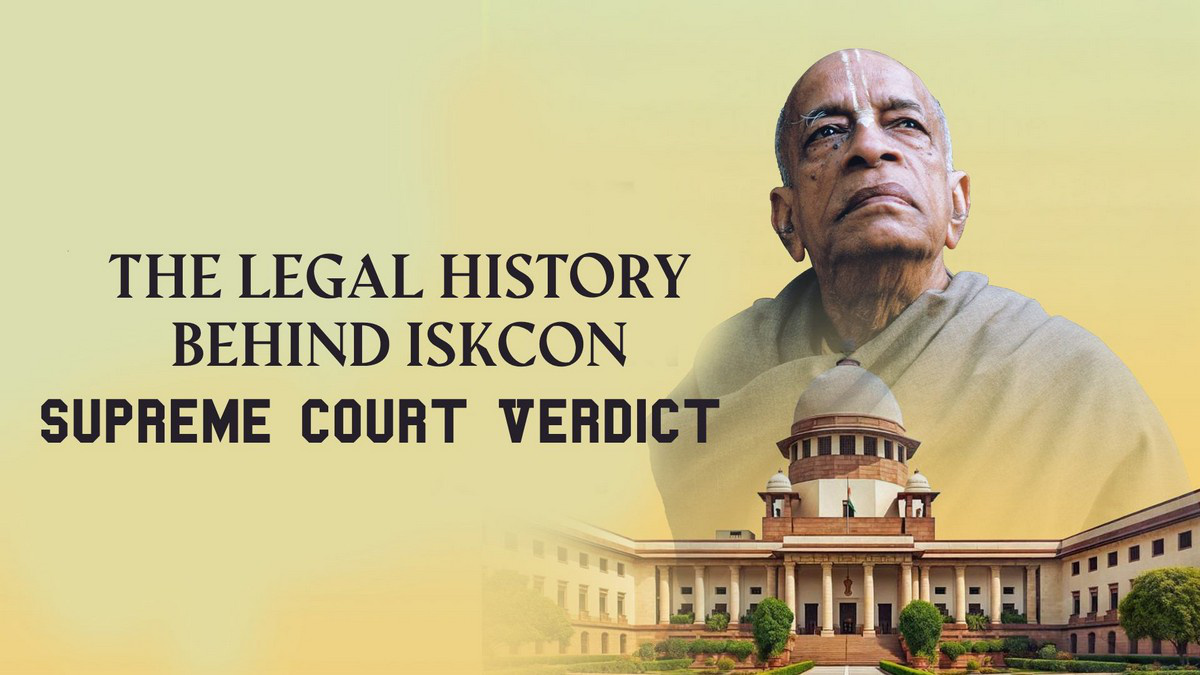
Supporters of the self-appointed gurus in ISKCON allege that Sri Madhu Pandit Dasa, President of ISKCON Bangalore, attempted to stealthily seize the temple property on Hare Krishna Hill from ISKCON Mumbai by using a defunct society called ISKCON Bangalore.
They claim that he used the theological dispute between ISKCON Mumbai and ISKCON Bangalore on the ritvik system merely as a pretext to retain complete control of the property with himself and never let anyone else disturb his ownership and control.
This article critically examines the veracity of these allegations.
The Legal Foundation of ISKCON Bangalore Society ISKCON Bangalore was legally registered under the Karnataka Societies Registration Act on May 7, 1978, as a legally independent society with objectives similar to those of ISKCON that Srila Prabhupada founded personally in 1966 in New York.
It was three years before Sri Madhu Pandit Dasa even joined ISKCON in 1981. The society was registered by Sri Shankabhrit Dasa under the direction of HH Hamsadutta Swami, then a GBC member appointed by Srila Prabhupada and overseeing Bengaluru. It was HH Jayapataka Swami who directed Sri Madhu Pandit Dasa to take over the responsibilities of the ISKCON Bangalore society in 1980.
Thus, the accusation that Sri Madhu Pandit Dasa created this society to usurp the property of the temple on Hare Krishna Hill is clearly baseless.
Ritvik System vs Self-Appointed Gurus In 1999, the devotees of ISKCON Bangalore, under the leadership of Sri Madhu Pandit Dasa, questioned the flawed guru system instituted in ISKCON after Srila Prabhupada’s disappearance. This system had perpetrated fraud and deceit among the innocent devotees of ISKCON all over the world for over four decades. They advocated for the ritvik system, as directed by Srila Prabhupada in his July 9, 1977 letter, wherein initiations were to be conducted
by representatives (ritviks), with Srila Prabhupada remaining the sole initiating acharya.
Since then, the leadership of ISKCON Mumbai—aligned with the self-appointed guru system— attempted multiple times to discredit and undermine ISKCON Bangalore and its leaders.
Legal Struggle to Protect ISKCON Bangalore’s Autonomy In 2000, ISKCON Mumbai attempted to take control of the temple on Hare Krishna Hill, although the land had been officially allotted to ISKCON Bangalore society in 1988 by the Bangalore Development Authority.
To protect its legitimate rights, ISKCON Bangalore filed a civil suit seeking an injunction to prevent ISKCON Mumbai and others from interfering with the possessions of ISKCON Bangalore.
While the trial court declined the injunction, an appeal filed before the High Court granted the injunction, and the order was later confirmed by the Supreme Court of India.
While the matter was pending adjudication, false propaganda was made, alleging that the ISKCON Bangalore society was “created” by Madhu Pandit Dasa to grab temple assets—a claim disproven by historical and legal facts, as mentioned earlier.
Mediation Attempts and ISKCON Mumbai’s Demands In connection with the dispute between ISKCON Bangalore and ISKCON Mumbai, one of the interim orders of the Supreme Court of India, dated June 6, 2011, stated: “However, we express a pious hope that the learned counsel appearing for the respective parties shall find some time and examine the possibility of amicably resolving the issues involved in the present matter. We would also expect that the different sections of this august institution would avoid unnecessary litigation and the office bearers of both the societies shall fully cooperate in this behalf.” Following this directive encouraging an amicable settlement, both parties agreed to mediation under retired Supreme Court Justice Sri R. V. Raveendran in March 2012.
Over the following months, several mediation meetings were held in Bengaluru under his chairmanship, attended by representatives of the Bureau (the Governing Body) of ISKCON Mumbai and the Governing Body of ISKCON Bangalore.
During the mediation, ISKCON Mumbai made the following five demands, one after the other.
Demand 1 – Control of the ISKCON Bangalore Temple ISKCON Mumbai sought to acquire the entire ownership and control of the ISKCON Sri Radha Krishna Temple on Hare Krishna Hill.
ISKCON Bangalore’s Response:Accepted—on the sole condition that only Srila Prabhupada be accepted as the sole acharya in the ISKCON Sri Radha Krishna Temple on Hare Krishna Hill, with initiations continuing through ritviks as per his July 9, 1977 directive.Demand 2 – Dual Temple Presidentship ISKCON Mumbai demanded a dual leadership structure for ISKCON Sri Radha Krishna
Temple: one Temple President from each group. The financial, legal and administrative control of the temple will vest with the Temple President of the ISKCON Mumbai group. The Deity worship, preaching and initiation aspects will be overseen by the Temple President of the ISKCON Bangalore group.
ISKCON Bangalore’s Response:Accepted—with the same condition: only Srila Prabhupada as the initiating acharya.
Demand 3 – Control of Additional Properties ISKCON Mumbai demanded complete control and ownership of other properties under the ISKCON Bangalore society in Kanakapura Road, Mysore, and Hubli.
The ISKCON Bangalore Society had acquired properties—land allotted by the government for specific projects—on Kanakapura Road in Bangalore, as well as in Mysore and Hubli. These acquisitions were made after the litigation had commenced and were not part of the suit schedule property. Therefore, the mediation should have ordinarily been confined to the disputed property—namely, the ISKCON Sri Radha Krishna Temple on Hare Krishna Hill.
However, the representatives of the Bureau of ISKCON Mumbai insisted that the mediation should aim to fully integrate both groups into a single ISKCON entity in India. They asserted that such unification could only be achieved if all properties of the ISKCON Bangalore Society— including those not under dispute—were brought under the ownership and control of ISKCON Mumbai.
ISKCON Bangalore’s Response:Accepted—on the same condition regarding Srila Prabhupada’s exclusive spiritual position.Demand 4 – Takeover of Trusts and Their Properties After litigation commenced between ISKCON Mumbai and ISKCON Bangalore in 1999, the devotees of ISKCON Bangalore had expanded the mission of Srila Prabhupada by establishing preaching centres and temples in sixteen locations across India.
To formalise these preaching efforts in line with the institutional framework outlined by Srila Prabhupada, separate trusts had been registered under the name and style of the Hare Krishna Movement. For over a decade, some of these trusts had been actively engaged in spreading Krishna consciousness, and some had also acquired properties in the course of their operations.
ISKCON Mumbai further insisted that all these trusts and their respective properties—though beyond the scope of the present litigation—should also be brought under its control and ownership in order to effect what it termed a “complete integration” of both groups. They stated that only under such a condition would they be able to secure a majority vote in the Bureau to approve the mediation.
ISKCON Bangalore’s Response: ISKCON Bangalore agreed to this proposal in full, placing only one condition—that Srila Prabhupada alone be worshipped as the sole guru or acharya of ISKCON in all these sixteen temples.Demand 5 – Removal of Key Devotees from Leadership ISKCON Mumbai demanded that Sri Madhu Pandit Dasa and three other leaders should no longer hold office in the ISKCON Sri Radha Krishna Temple on Hare Krishna Hill, citing their involvement in the ongoing litigation.
It is noteworthy that these devotees were instrumental in securing the land allotment, mobilising funds and supporters, and overseeing the construction of the magnificent temple that now stands as Hare Krishna Hill—a spiritual landmark that has brought immense pride to the city of Bengaluru. Their efforts were supported by a committed and hardworking team of devotees.
However, ISKCON Mumbai insisted that these leaders relinquish their services at Hare Krishna
Hill and instead take up responsibilities in other temples. The representatives of the Bureau of ISKCON Mumbai conveyed that only if this condition was accepted would there be any possibility of a complete mediated settlement.
ISKCON Bangalore’s Response:Accepted—again, with the same condition that Srila Prabhupada’s ritvik system be followed in ISKCON Bangalore group of temples.
Rejection by ISKCON Mumbai and the International GBC Despite ISKCON Bangalore accepting all of ISKCON Mumbai’s demands, the International GBC and the Bureau of ISKCON Mumbai rejected the only condition ISKCON Bangalore proposed: adherence to the ritvik system.
Instead, they offered to appoint some senior devotees of ISKCON Bangalore as regular initiating gurus—an offer that was categorically rejected by ISKCON Bangalore, reaffirming that the matter was theological, not personal or material.
The Basis of ISKCON Bangalore’s Stand Srila Prabhupada taught that one can become a bona fide spiritual master when authorised by one’s predecessor spiritual master.
“One should take initiation from a bona fide spiritual master coming in the disciplic succession, who is authorized by his predecessor spiritual master. This is called diksha-vidhana.” (Srila Prabhupada, Srimad Bhagavatam 4.8.54 Purport) “When I order, ‘You become guru,’ he becomes regular guru. That’s all.” (Room conversation with Srila Prabhupada, Vrindavan, 28 May 1977) Srila Prabhupada never ordered any of his disciples to become a regular guru after his disappearance. Instead, he issued a directive appointing eleven ritviks to initiate on his behalf.
However, in 1978, these ritviks assumed the position of diksha-gurus on the same level as Srila Prabhupada, thereby establishing a new, unauthorized system of self-proclaimed gurus— contrary to Srila Prabhupada’s original instructions.
Letter from ISKCON Bangalore Group Leaders In a letter dated March 14, 2013, the Temple Presidents of ISKCON Bangalore group expressed disappointment that their only request—acceptance of the ritvik system—was rejected, despite their willingness to hand over all properties and leadership positions.
They emphasised that the ritvik system offers a straightforward solution to many ongoing issues in ISKCON, such as guru falldowns, internal conflicts, lack of transparency, parallel and conflicting lines of authorities, and minimisation of Srila Prabhupada’s pre-eminent position in ISKCON.
The Final Verdict by the Supreme Court On May 16, 2025, the Supreme Court of India ruled in favour of ISKCON Bangalore, affirming ISKCON Bangalore’s stance: Srila Prabhupada remains the sole acharya of ISKCON.
The Court decreed that the ISKCON Hare Krishna Hill temple in Bangalore belongs to ISKCON Bangalore society, not ISKCON Mumbai society, and issued an injunction prohibiting ISKCON Mumbai from interfering in ISKCON Bangalore’s affairs.
A Renewed Offer for Peace Despite this decisive legal victory, Sri Madhu Pandit Dasa once again extended a peace offer to
ISKCON’s International GBC and ISKCON Mumbai.
As a gesture of goodwill and in the spirit of unity, the GBC of the ISKCON Bangalore group of temples expressed their willingness to come under the umbrella of the International GBC—on the sole condition that the ritvik system of initiation, as instituted by Srila Prabhupada in his directive dated July 9, 1977, be accepted and implemented in these temples.
This peace proposal was rejected by the Executive Committee of the ISKCON GBC, which reaffirmed its earlier 1990 resolution opposing the ritvik system.
Conclusion The entire history of the conflict and mediation shows that ISKCON Bangalore—led by Sri Madhu Pandit Dasa—was never driven by personal ambition, desire for power, or control of properties.
ISKCON Bangalore accepted all of ISKCON Mumbai’s demands concerning property ownership and leadership changes—on one condition: that the ritvik system of initiation, as instituted by Srila Prabhupada in his directive dated July 9, 1977, be recognised and followed in all the temples under the ISKCON Bangalore group.
Even when offered the position of initiating gurus, the leaders of ISKCON Bangalore rejected it to uphold Srila Prabhupada’s instruction.
After winning the Supreme Court case, they once again offered peace on the same principle.
If ISKCON Bangalore’s objective had been the acquisition of power or property, such generous offers would never have been extended. The facts clearly and irrefutably demonstrate that the real issue at hand is theological.
For ISKCON Bangalore, the true victory lies not in possessing property to preach Krishna consciousness, but in faithfully adhering to Srila Prabhupada’s instructions—most notably, the ritvik system of initiation.