The Glorious Role of Srila Prabhupada in ISKCON and spiritual lives of all ISKCON devotees (2018)
Discover the true meaning of Diksha as taught by Srila Prabhupada. Learn its 6 essential features from the daily Guru Puja song in ISKCON.
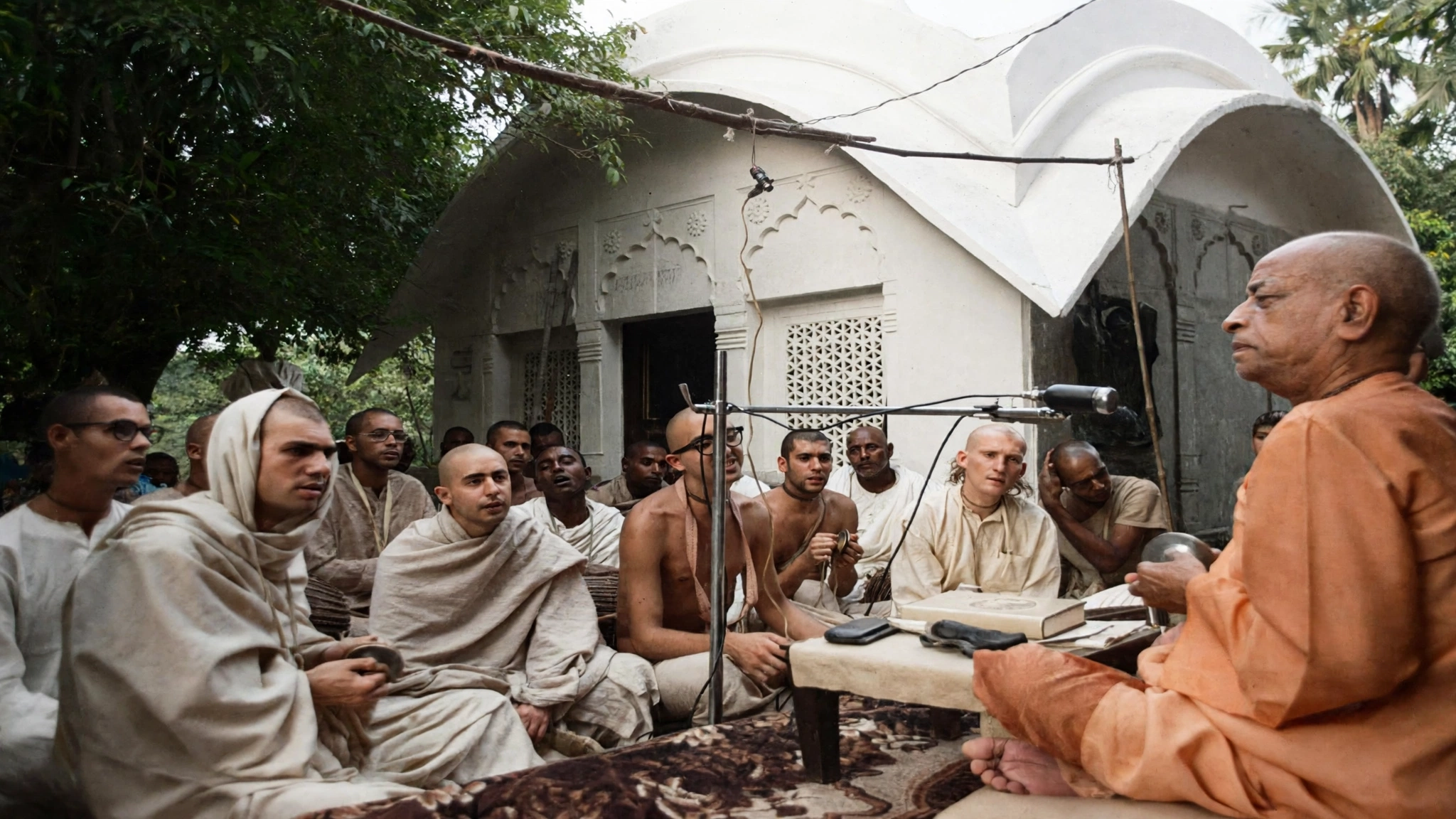
Diksha or Initiation in Vedic Tradition
Diksha or initiation is a practice and ceremony in Vedic tradition. As there are many Vedic traditions in India, there are many different practices and understandings of diksha. The traditions of Shankara, Madhva, Ramanuja - all have their practices and understanding of diksha or initiations. The Jains and Buddhists too have their versions of diksha or initiation. Hence while discussing the meaning, significance and rituals of diksha in Vedic traditions, we must be conscious of the nuances that exist among the different traditions.
Srila Prabhupada is an empowered Acharya fulfilling the prophesies of the Vedic scriptures, Sri Chaitanya Mahaprabhu and the previous acharyas that the science of pure love of God or Krishna consciousness will go beyond the shores of India and benefit sincere souls seeking genuine spiritual life all over the world. Hence when Srila Prabhupada introduced diksha in ISKCON, it is important to understand the meaning and significance of diksha that he introduced in ISKCON.
Srila Prabhupada explained the important elements and features of diskha or initiation during different occasions including some of the initiation lectures. Here are a few:
1. Initiation means to officially accept to abide by the orders of Kṛṣṇa and His representative.
2. “If you are serious about practicing Krishna consciousness, that is real initiation;” “It is your determination to follow the rules and regulations. That is initiation.”
3. The spiritual master agrees to deliver the disciple from the material world.
4. The spiritual master agrees to deliver Krishna to the sincere disciple.
5. The Lord is transferred from the heart of the spiritual master to the heart of the disciple by diksha or initiation.
6. Awakening of transcendental knowledge in the heart of a disciple is diksha.
(This list is not comprehensive, but relevant to the present discussion).
Daily Guru Puja Introduced by Srila Prabhupada
In 1974 in Bombay, Srila Prabhupada introduced daily guru puja as part of the standard daily morning program in ISKCON temples. Later he explained the importance of this daily guru puja:
“And because the spiritual master enlightens the (disciple with) divya-jṣāna, one feels obliged to him. Yasya prasādād bhagavat-prasādo yasya prasādān na gatiḥ kuto 'pi. So this guru-pūjā is essential. As the Deity worship is essential... It is not cheap adoration. It is the process of enlightening (with) divya-jṣāna. (Lecture, Bombay, April 1st, 1977)
Srila Prabhupada introduced the singing of Sri Guru Vandana by Srila Narottama Das Thakura during the guru puja. Today all ISKCON devotees offer daily guru puja to the Deity of Srila Prabhupada and sing this song in all the ISKCON temples all over the world.
If we notice carefully, the meaning, features and elements of diksha or initiation are described in this guru puja song. Here we tabulate the elements of diksha or initiation as explained by Srila Prabhupada and the words from the guru puja song also with explanations by Srila Prabhupada himself:
The Real Meaning and Understanding of Diksha or Initiation? What are it’s essential elements and features?
The Guru Vandana song that we sing to Srila Prabhupada every day in all ISKCON temples describes these very elements or aspects of diksha or initiation:
1. Initiation means to officially accept to abide by the orders of Kṛṣṇa and His representative:
Devotee: How important is formal initiation?
Srila Prabhupāda: Formal initiation means to accept officially, to abide by the orders of Kṛṣṇa and His representative. That is formal initiation. Officially accept, "Yes, sir, I shall accept. I shall do whatever you say." This is initiation, official acceptance of the job. That's all. Now, you formally accept, and if you do not do the duties, then where is the question of other function? There is no question. Initiation means this is the beginning of accepting to carry out the orders of Kṛṣṇa and His representative. This is the beginning. That is initiation. Just like if you enter in an office establishment, so you accept the terms of service. That is initiation. Then you go on serving, you become promoted, you get salary increase. You become recognized. You become officer. You become big officer, like that. That very word initiation suggests, "This is the beginning." … So dīkṣā means the initiation to begin transcendental activities. That is called initiation. Therefore we take promise from the disciple, "Will you chant so many times." "Yes, sir." "Will you observe these rules and regulations," "Yes, sir." That is initiation. He has to observe; he has to chant. Then everything comes automatically. (SB class, Auckland, Feb 22nd, 1973)
guru-mukha-padma-vākya, cittete koriyā aikya, ār nā koriho mane āśā.
“You are singing every day, guru-mukha-padma-vākya, cittete koriyā aikya, ār nā koriho mane āśā. This is life. This is life. Guru-mukha-padma vakya... You accept the bona fide guru, and what he orders you, carry out. Then your life is successful. Ār nā koriho mane āśā. You do not desire anything else. Are you not singing daily? ... Yes, what is the meaning?
Devotee: "My only wish is that my mind be purified by the words coming from the mouth of my spiritual master. I have no other desire but this."
Prabhupāda: Yes. This is the order. Guru-mukha-padma-vākya, cittete koriyā aikya. Now citta means consciousness or heart. "I shall do this only, bas. My Guru Mahārāja told me; I shall do this." Cittete koriyā aikya, ār nā koriho mane āśā. So it is not my pride, but I can say, for your instruction, I did it. Therefore whatever little success you see than all my Godbrothers, it is due to this. I have no capacity, but I took the words of my guru as life and soul. So this is fact. Guru-mukha-padma-vākya, cittete koriyā aikya. Everyone should do that. (Srimad Bhagavatam class, July 12th. 1975, Philadelphia).
2. “If you are serious about practicing Krishna consciousness, that is real initiation;”
“It is your determination to follow the rules and regulations. That is initiation.”
Initiation is a formality. First of all you have to decide whether you will abide by the rules and regulations and become Kṛṣṇa conscious. That is your consideration. You have to decide for yourself whether you are going to take this Kṛṣṇa consciousness seriously. That is your decision. Initiation is a formality. If you are serious, that is real initiation. If you have understood this Kṛṣṇa philosophy and if you have decided that you will take Kṛṣṇa consciousness seriously and preach the philosophy to others, that is your initiation. My touch is simply a formality. It is your determination. That is initiation. (Conversation with Mr. Paul Valliere, an Instructor of Religion at Columbia University in New York City.)
Guru-mukha-padma-vākya, cittete kariyā, āra nā kariyā mane āśā
Cittete kariyā aikya. Now this is the determination. We must approach the real guru, empowered guru, with power of attorney. Then if we take his word... Guru-mukha-padma-vākya, cittete kariyā, āra nā kariyā mane āśā.... Don't try to manufacture ideas. Then if you take up the order of the spiritual master seriously, then your life is successful. Guru-mukha-padma, cittete, āra nā kariyā mane āśā. Don't spoil yourself by manufacturing ideas. Take word from him. You carry it out. Don't bother whether you'll be spiritually advanced or not, but take the word of the spiritual master and carry it. Then everything is guaranteed. Guru-mukha-padma-vākya, cittete koriyā aikya, āra nā koriyā mane āśā. (CC class, July 11th, 1976, New York)
3. Deliverance from the material world:
It is the spiritual master who delivers the disciple from the clutches of māyā by initiating him into the chanting of the Hare Kṛṣṇa mahā-mantra. In this way a sleeping human being can revive his consciousness by chanting Hare Kṛṣṇa, Hare Kṛṣṇa, Kṛṣṇa Kṛṣṇa, Hare Hare/ Hare Rāma, Hare Rāma, Rāma Rāma, Hare Hare. (Śrī Caitanya-caritāmṛta Madhya-līlā 9.61)
Yāṅhāra prasāde bhāi, ei bhava toriyā yāi.
So why one should go to spiritual master? Because yāṅhāra prasāde bhāi: "My dear brother, if you get the benediction from the spiritual master..." Yāṅhāra prasāde bhāi, ei bhava toriyā yāi. What is that benediction? … the miracle of spiritual master is yāṅhāra prasāde bhāi, ei bhava toriyā yāi. This is miracle: no more material existence. Then ei bhava toriyā yāi. So real thing (?) is one can cross over the ocean of nescience. That is real gain. That is the real favor of spiritual master, … Ei bhava toriyā yāi. (CC class, July 11th, 1976, New York)
4. The spiritual master agrees to deliver Krishna to the sincere disciple:
"Does what you told us this morning (about initiation)," Howard asked, "mean we are supposed to accept the spiritual master to be God?" "That means he is due the same respect as God, being God's representative," Prabhupāda replied, calmly. "Then he is not God?" "No," Prabhupāda said, "God is God. The spiritual master is His representative. Therefore, he is as good as God because he can deliver God to the sincere disciple. Is that clear?" It was. (Planting the Seed, New York, 1965-66 by Satsvarupa Dasa Goswami)
Kṛṣṇa-prāpti hoy yāhā haite.
“Kṛṣṇa-prāpti hoy yāhā haite. That is spiritual master, one who can give you Kṛṣṇa. … Kṛṣṇa is not independent. He is the property of the devotee. Kṛṣṇa se tomāra, kṛṣṇa dite pāra, dhāi tava pāche pāche: "I am just following you, sir. Because Kṛṣṇa is your property, if you like, you can deliver: 'Take it immediately.’ ” So it is not flattering; it is in the śāstras. (CC class, July 11th, 1976, New York)
5. The Lord is transferred from the heart of the spiritual master to the heart of the disciple by diksha or initiation:
“As indicated here by the word manastaḥ, the Supreme Personality of Godhead was transferred from the core of Vasudeva's mind or heart to the core of the heart of Devakī. We should note carefully that the Lord was transferred to Devakī not by the ordinary way for a human being, but by dīkṣā, initiation. Thus the importance of initiation is mentioned here. Unless one is initiated by the right person, who always carries within his heart the Supreme Personality of Godhead, one cannot acquire the power to carry the Supreme Godhead within the core of one's own heart….. Yogīs meditate upon the Supreme person within the mind. For a devotee, however, the Lord is present, and His presence need only be awakened through initiation by a bona fide spiritual master. (Srimad Bhagavatam, 10.2.18 purport)
Kṛṣṇa-prāpti hoy yāhā haite.
guru-mukha-padma-vākya, cittete kariyā aikya,
āra nā koriha mane āśā
Simply execute that. Kṛṣṇa prāpti haya yāhā haite. You'll get Kṛṣṇa. (June 22nd, 1976, New Vrindavan) Guru means one who can give you Kṛṣṇa. That is guru. (BG class, Aug 7th, 1973, London). If you approach a devotee of Kṛṣṇa, he can deliver you Kṛṣṇa like anything: "Here is Kṛṣṇa. Take." Kṛṣṇa is so nice. He becomes a doll in the hands of devotee. He agrees. Just like before mother Yaśodā He was trembling. Mother Yaśodā showed Him the cane. (Sri Brahma Samhita lectures, July 27th, 1971, New York).
6. Awakening of transcendental knowledge is diksha
“Dīkṣā is the process by which one can awaken his transcendental knowledge…” (CC Madhya 15.108 purport) Divya-jṣāna is (understanding) that we are all servant of Kṛṣṇa, and our only business is to serve Kṛṣṇa. This is divya-jṣāna. It is not difficult at all. We have become servant of so many things—servant of society, servant of community, servant of country, servant of wife, servant of children, servant of dog and so many. "Now let me become servant of Kṛṣṇa." This is divya-jṣāna. Dīkṣā. Dīkṣā comes from this divya-jṣāna. (CC class, July 11th, 1976, New York)
Divya-jṣāna hṛde prakāśito
Divya-jṣāna hṛde prakāśito. So this is the duty of the guru, to awaken that divya-jṣāna. And because guru enlightens that divya-jṣāna, he is worshiped. That is required.
Guru Puja - The Initiation Song
All the essential features of diksha or initiation listed above are described in the daily guru puja song that all ISKCON devotees sing before the vigraha of Srila Prabhupada. In fact the daily guru puja song can be practically called the “Initiation song.” The daily guru puja has become the essential part of ISKCON daily life for all ISKCON devotees all over the world.
It is also to be noted that Srila Prabhupada introduced the daily guru puja practice in ISKCON temples and this was not the custom in the Gaudiya Math.
Not only did Srila Prabhupada introduce daily guru puja as part of the morning program in all ISKCON temples, he placed a lot of importance to this daily guru puja.
Once HH Jayapataka Maharaj shared with us in Bangalore an instruction that he personally received from Srila Prabhupada.
It was during the mid-1970s. Lot of construction work was going on in Mayapur and there was a deadline to complete the construction of the buildings. And Jayapataka Maharaj was overseeing them. Once during morning program, Srila Prabhupada noticed that Jayapataka Maharaja was not attending the guru puja and asked the other devotees present, “Where is Jayapataka?” Srila Prabhupada was told that probably due to the intense construction work going on, he was preoccupied with some service. Later Srila Prabhupada instructed Jayapataka Maharaja, “Even if you are busy with services and have to miss the morning sadhana program, you should at least attend the guru puja.”
Considering all these, there is little doubt, Srila Prabhupada is playing an active, significant and spiritually potent role in the spiritual lives of all ISKCON devotees all over the world. If we take Srila Prabhupada’s instructions seriously with determination, as the guru puja song states, he will deliver us from this material world, awaken transcendental knowledge and give us Krishna. All of these are the features of diksha or initiation that Srila Prabhupada introduced in ISKCON. Hence Srila Prabhupada is in fact playing the role of diksha guru for all devotees in ISKCON.
This glorious role of Srila Prabhupada must be recognised and celebrated in all ISKCON temples and in the spiritual lives of all ISKCON devotees. Sadly this is not happening and the ISKCON’s International GBC has been obstructing such a recognition of Srila Prabhupada’s role!
In this context it is appropriate to recall what Srila Prabhupada said in the Radio interview on March 12th, 1968, in San Francisco:
“I am the spiritual master of this institution, and all the members of the society, they're supposed to be my disciples. They follow the rules and regulations which I ask them to follow, and they are initiated by me spiritually.”