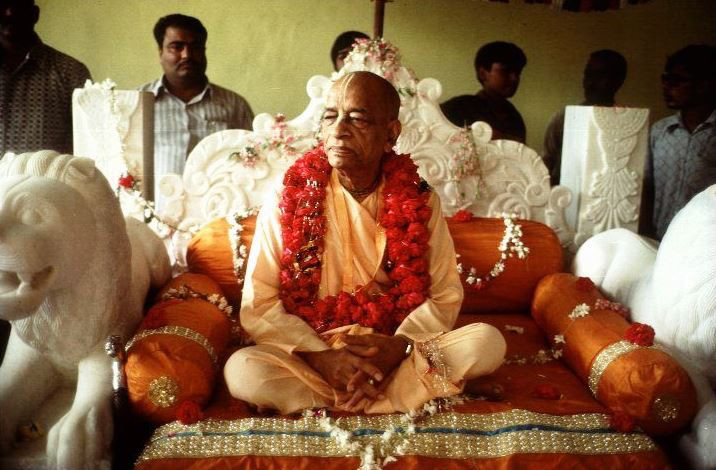
By: Vidura Dasa, California, USA A common argument nowadays is whether or not one can take Diksha initiation from a spiritual master who is not physically present on the planet. Aside from the fact that such a restriction is completely nonexistent in Srila Prabhupada's books, supporters of that argument don’t seem to understand what exactly a Spiritual Master is. So before anything, let us first properly define the above key words being argued upon, which are: – Diksha initiation – Spiritual Master – Physical presence As our sole guide and basis of understanding such terms, we will be using His Divine Grace Srila Prabhupada's own words. He is, after all, the most relevant, being the most recent link in the disciplic succession. Statements from Srila Prabhupada will be in green. Statements made up by myself in order to illustrate a point will be in red. 1) Diksha initiation: "Diksha actually means initiating a disciple with transcendental knowledge by which he becomes freed from all material contamination." C.c. Madhya, 4.111, purport "In other words, the spiritual master awakens the sleeping living entity to his original consciousness so that he can worship Lord Vishnu. This is the purpose of diksha, or initiation.
Initiation means receiving the pure knowledge of spiritual consciousness." C.c. Madhya, 9.61, purport Supporting evidence: "The chanting of Hare Krishna is our main business, that is real initiation. And as you are all following my instruction, in that matter, the initiator is already there." Srila Prabhupada Letter to Tamal Krishna, 19/8/68
"Initiation is a formality. If you are serious, that is real initiation. My touch is simply a formality. It is your determination, that is initiation." "The Search for the Divine", Back To Godhead #49 So here we see that Diksha initiation is the receipt of transcendental knowledge. Thus far a safe statement to make would be: "One must receive transcendental knowledge from a bonafide spiritual master." Let us now define our next term: 2) Spiritual Master: "A spiritual master is the principle, not the body." SP Letter to Malati, 28/5/68 "There is no difference between the spiritual master’s instructions and the spiritual master himself." C.c. Adi 1.35, purport Supporting evidence: "To serve master's word is more important than to serve physically." SP Room Conversation, Vrindavan, 2/5/77 "If you actually follow the words of Guru, that means he is pleased. And if you do not follow, how can he be pleased?" Morning Walk, 21/7/75, San Francisco So thus far, a safe statement to make would be: "One must receive transcendental knowledge from [following] the (a) bonafide principle/instruction (spiritual master)." The term 'physical presence' actually starts to become redundant because if we could receive transcendental knowledge or Diksha from the instructions or spiritual master then automatically the need for the physical body is eliminated. Nevertheless, we will continue to define the term 'physical presence' and see what Srila Prabhupada has to say. 3) Physical presence: "So although a physical body is not present, the vibration should be accepted as the presence of the Spiritual Master, vibration. What we have heard from the Spiritual Master, that is living." Letter, 13/01/69, Los Angeles "We are not separated actually. There are two – Vani or Vapuh – so Vapuh is physical presence and Vani is presence by the vibration, but they are all the same." Letter to Hamsaduta, 22/6/70 Supporting evidence: "…association with Krishna and the Spiritual Master should be association by vibration not physical presence. That is real association." Elevation to Krishna Consciousness, chapter 4 "one has to associate with liberated persons not directly, physically, but by understanding, through philosophy and logic, the problems of life." SB 3:31:48 purport So since we see that Srila Prabhupada has equated 'physical presence' with vani or vibration, and not only equated but even prioritized, it would now be safe to say: "One must receive transcendental knowledge (Diksha) from the vibrational presence (or
physical presence) of [following] the principle/instruction (Spiritual Master)." This statement is sort of redundant, and only emphasizes the fact that a physical body is not actually needed for the main purpose of Diksha.
In simpler terms we could say: "One must receive transcendental knowledge from following the instruction of the Spiritual Master." Thus we have quotes such as: "The spiritual master by his words, can penetrate into the heart of the suffering person and inject knowledge transcendental which alone can extinguish the fire of material existence." S.B. 17.22, purport "This is the process of initiation. The disciple must admit that he will no longer commit sinful activity […] He promises to execute the order of the spiritual master. Then, the spiritual master takes care of him and elevates him to spiritual emancipation." C.c. Madhya, 24.256, purport I don't think Srila Prabhupada could have been any clearer on the matter.
All Glories to Srila Prabhupada!