Change of heart comes from accepting order of guru without argument
Puṣṭa Kṛṣṇa: What is the sign that someone is actually having change in heart? Prabhupāda: By his action. [break] …kasipu tried to make Prahlāda atheist. He failed.
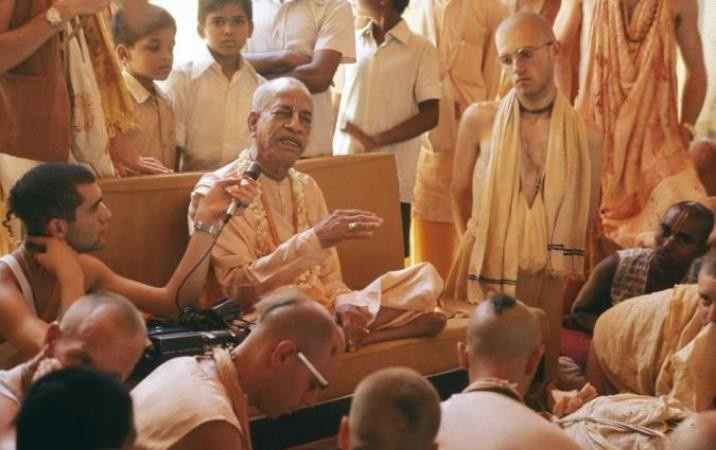
Puṣṭa Kṛṣṇa: What is the sign that someone is actually having change in heart?
Prabhupāda: By his action. [break] …kasipu tried to make Prahlāda atheist. He failed. And Prahlāda tried to make his father theist. He failed. Don't you see?
Puṣṭa Kṛṣṇa: Yes.
Prabhupāda: So unless one agrees you cannot turn him. It is not possible. Five-years'-old boy, staunch devotee, and the powerful Hiraṇyakaśipu, father, who is threatening with his life and so many ways he tried that "You become atheist, godless. Otherwise I shall kill you." He did not agree. And similarly, the son also solicited the father that "You have got so much power by the grace of God. Why you are becoming atheist?" Both of them could not turn to their side.
Prahlāda remained Prahlāda, and Hiraṇyakaśipu remained Hiraṇyakaśipu. [break] …can expect that without agreeing, conceding, one can be reformed. No, that is not possible. Impossible.
Puṣṭa Kṛṣṇa: Not simply by rubber stamp.
Prabhupāda: No, that is not possible. He must agree, "Yes." Therefore guru is required. Guru means, accept guru means, "Whatever you say, I will accept." That is guru. Otherwise friendly talk. Friendly talk will not do. To accept guru means "Now I accept you, guru, my instructor, without any argument," and that is acceptance. "Whatever you say, I shall do." That is agreement. Then he can be reformed. Śiṣyas te 'ha śādhi mā prapannam: "I surrender unto you. I become your disciple. Now you train me." Then he can be reformed. Otherwise not possible. [break] “Guru-mukha-padma-vakya, cittete koriya aikya, ara na koriho mane asa. Don’t think of any nonsense. Simply execute what your guru has said. That is success.” Srila Prabhupada Room conversation, January 28, 1977 "When our men become sahajiya they will become more dangerous"—SP To judge who is actually his disciple, to divide the useful from the useless, one must measure
the activities of such disciples in executing the will of the spiritual master.
Adi 12.12- Paddy is mixed with straw at first, and one must fan it to separate the paddy from the straw.
PURPORT-This example given by Kṛṣṇadāsa Kavirāja Gosvāmī is very appropriate. In the case of the Gauḍīya Maṭha members, one can apply a similar process. There are many disciples of Bhaktisiddhānta Sarasvatī Ṭhākura, but to judge who is actually his disciple, to divide the useful from the useless, one must measure the activities of such disciples in executing the will of the spiritual master. Bhaktisiddhānta Sarasvatī Ṭhākura tried his best to spread the cult of Śrī Caitanya Mahāprabhu to countries outside India. When he was present he patronized the disciples to go outside India to preach the cult of Śrī Caitanya Mahāprabhu, but they were unsuccessful because within their minds they were not actually serious about preaching His cult in foreign countries; they simply wanted to take credit for having gone to foreign lands and utilize this recognition in India by advertising themselves as repatriated preachers.
Many svāmīs have adopted this hypocritical means of preaching for the last eighty years or more, but no one could preach the real cult of Kṛṣṇa consciousness all over the world. They merely came back to India falsely advertising that they had converted all the foreigners to the ideas of Vedānta or Kṛṣṇa consciousness, and then they collected funds in India and lived satisfied lives of material comfort. As one fans paddy to separate the real paddy from useless straw, by accepting the criterion recommended by Kṛṣṇadāsa Kavirāja Gosvāmī one can very easily understand who is a genuine world-preacher and who is useless.
Spiritual potency because of that person’s offenseless utterance Sri Caitanya-Caritamrta Antya-Lila 3.59 namera aksara-sabera ei ta’ svabhava vyavahita haile na chade apana-prabhava TRANSLATION-“The letters of the holy name have so much spiritual potency that they act even when uttered improperly.
PURPORT-Srila Bhaktisiddhanta Sarasvati Thakura states that the word vyavahita (“improperly uttered”) is not used here to refer to the mundane vibration of the letters of alphabet. Such negligent utterance for the sense gratification of materialistic person is not a vibration of transcendental sound. Utterance of the holy name while one engages in sense gratification is an impediment on the path toward achieving ecstatic love for Krsna. On the other hand, if one who is eager for devotional service utters the holy name even partially or improperly, the holy name, who is identical with the Supreme Personality of Godhead, exhibits its spiritual potency because of that person’s offenseless utterance. Thus, one is relieved from all unwanted practices, and one gradually awakens his dormant love for Krsna.
For the chanting to be effective If one actually wants to derive the effects of chanting, one must strictly follow the great ācāryas.
The Pañca-tattva is a very important factor in understanding Śrī Caitanya Mahāprabhu. There are sahajiyās who, not knowing the importance of the Pañca-tattva, concoct their own slogans, such as bhaja nitāi gaura, rādhe śyāma, japa hare kṛṣṇa hare rāma or śrī-kṛṣṇa-caitanya prabhu-nityānanda hare kṛṣṇa hare rāma śrī-rādhe govinda.
Such chants may be good poetry, but they cannot help us to go forward in devotional service. In
such chants there are also many discrepancies, which need not be discussed here. Strictly speaking, when chanting the names of the Pañca-tattva, one should fully offer his obeisances: śrī-kṛṣṇa-caitanya prabhu-nityānanda śrī-advaita gadādhara śrīvāsādi-gaura- bhakta-vṛnda. By such chanting one is blessed with the competency to chant the Hare Kṛṣṇa mahā-mantra without offense. When chanting the Hare Kṛṣṇa mahā-mantra, one should also chant it fully: Hare Kṛṣṇa, Hare Kṛṣṇa, Kṛṣṇa Kṛṣṇa, Hare Hare Hare Rāma, Hare Rāma, Rāma Rāma, Hare Hare. One should not foolishly adopt any of the slogan sconcocted by imaginative devotees. If one actually wants to derive the effects of chanting, one must strictly follow the great ācāryas. This is confirmed in the Mahābhārata: mahā-jano yena gataḥ sa panthāḥ. "The real path of progress is that which is traversed by great ācāryas and authorities." Cc Adi 7.168 : PURPORT Anyone can chant, but they must know it, that "If I chant in the proper process, then it will be effective." Rāmeśvara: 'Cause sometimes when we interview these people who are chanting, they speak from their own realization, and it is not exactly the version of Śukadeva Gosvāmī, it is not…, but it is their own realization, whatever little bit they have realized.
Srila Prabhupāda: No, no. They may chant, but they must understand that the chanting process, that will be more effective. That they must know. Chanting is open. Anyone can chant, but they must know it, that "If I chant in the proper process, then it will be effective." …Rāmeśvara: Just like this Alice Coltrane. She has done her small part. She made this record album with Govinda Jaya Jaya and Hare Kṛṣṇa.
Srila Prabhupāda: That is… That will be a good thing. But when he (she) does it properly it will be more effective, because there is… If one does not chant in the process, then gradually it degrades. The offense will increase. There is chance.
Feb 25 19787 Mayapur One must receive all kinds of mantras from a bona fide spiritual master; otherwise the mantras will not be fruitful. This is also indicated in Bhagavad-gita (4.34): tad viddhi pranipatena pariprasnena sevaya upadeksyanti te jnanam jnaninas tattva-darsinah "Just try to learn the truth by approaching a spiritual master. Inquire from him submissively and render service unto him. The self-realized soul can impart knowledge unto you because he has seen the truth."All mantras should be received through the authorized guru, and the disciple must satisfy the guru in all respects, after surrendering at his lotus feet. In the Padma Purana it is also said, sampradaya-vihina ye mantras te nisphala matah. There are four sampradayas, or disciplic successions, namely the Brahma-sampradaya, the Rudra-sampradaya, the Sri sampradaya and the Kumara-sampradaya. If one wants to advance in spiritual power, one must receive his mantras from one of these bona fide sampradayas; otherwise he will never successfully advance in spiritual life.
SB 6.8.42 Purport