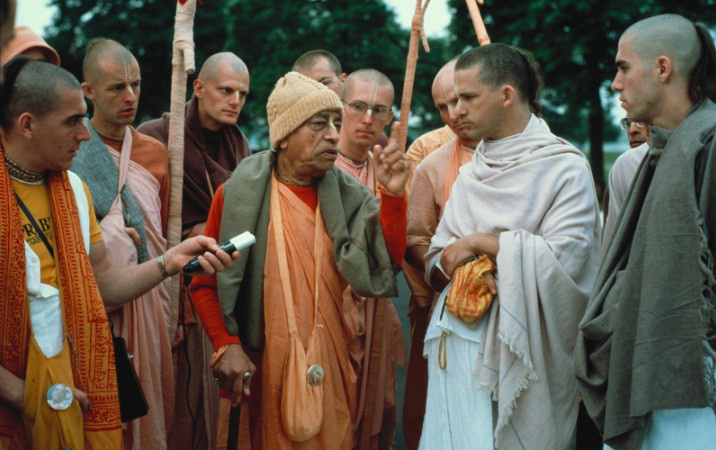
His Divine Grace A.C.Bhaktivedanta Swami Prabhupada, reverentially addressed as Srila Prabhupada by his followers, travelled to New York city in 1965, when he was 70 years old, to teach the principles of Krishna consciousness. He was ordered by his spiritual master to spread the knowledge of Bhagavad-gita and Srimad Bhagavatam all over the world, to bring about harmony in the spiritually misdirected society and help peoples of the world to achieve the highest perfection of life. In pursuance of this order of his revered spiritual master, Srila Prabhupada had made incessant attempts for three decades (1936 – 1965), to spread the message of Bhagavad-gita and Srimad Bhagavatam by publishing magazines, authoring books, conducting public programs, founding an institution. But these attempts did not yield much success. As a final attempt he ventured to travel out of the country to create interest among Westerners in the message of the Bhagavad-gita and Srimad Bhagavatam. When he set out of the country in a cargo ship, he carried with him a mere Rs.40, a trunk load of Srimad Bhagavatam books in three volumes, (which he had translated to English with elaborate commentaries) and unlimited faith in the order of his spiritual master.
In summer of 1966, he founded ISKCON (International Society for Krishna consciousness) in New York City. To his surprise, the young men and women of western countries took keen interest in the message of Bhagavad-gita and Srimad Bhagavatam and came forward to assist him in spreading his mission. Between 1966 and 1977, he travelled fourteen times around the globe and established 108 Krishna temples all over the world. In the midst of his travel schedule, organizing and managing a worldwide institution and inspiring and directing thousands of disciples, he authored over seventy books on the science of Krishna consciousness from the Vedic literatures. Srila Prabhupada spent his final days in his own temple in Vrindavan and disappeared from this world in November 1977.
Srila Prabhupada entrusted the management of the worldwide ISKCON in the hands of the International Governing Body Council (GBC), a body of his senior disciples.
During Srila Prabhupada’s physical presence, he initiated all the spiritual aspirants who came to
ISKCON as his disciples. He was their guru, Acharya and spiritual master. In the initial days of ISKCON, he personally trained his disciples and guided them. As ISKCON grew into a worldwide organization, he continued to inspire, teach and train thousands of disciples all over the world through his lectures, correspondence (he wrote thousands of letters), books, senior disciples and the institution he established.
Towards the end of his life, knowing that his disciples were still young and novices in their spiritual lives, and some of them still afflicted with material ambitions for power and authority in the institution, Srila Prabhupada did not appoint any one of them as an Acharya of ISKCON to succeed him after his physical departure in 1977. After his physical presence, for initiating new spiritual aspirants who join ISKCON, he appointed eleven of his senior disciples to act as ritviks or representatives of the Acharya. In a written institutional directive that he issued on July 9, 1977, five months before his passing away, he outlined how initiation of new spiritual aspirants should be conducted through the ritviks and that they will be his disciples. (Institutional directive of July 9, 1977 – Enclosure-3 page 20). In this way, he intended to be the Acharya of ISKCON and continue to initiate the new devotees who approach ISKCON for spiritual shelter through the ritviks.
But soon after his passing away in November 1977, these eleven disciples declared themselves to be successor Acharyas and started initiating new spiritual aspirants coming to ISKCON as their disciples. They started accepting the highest level of adoration, supplication and submission from their earnest and innocent disciples. They sat on decorated thrones in the ISKCON temples and received elaborate worship (guru and Vyasa puja) that included feet bathing with milk and honey. While they received such level of worship from their disciples, many of them secretly pursued a private life of most deplorable and sinful activities. To protect their positions of power and authority and continue their exploitation of the innocent sentiments of spiritual seekers, they were also involved in complex intrigues, plotting and cover-ups. All of this in contrast to the simple and saintly life Srila Prabhupada had led and taught for all his disciples, especially his leaders. The abuse of power and authority by these eleven self- appointed Acharyas is a less exposed and well guarded secret that constitutes the dark history of ISKCON. Subsequently most of the eleven self-appointed Acharyas had dramatic and disgraceful fall down from basic spiritual standards to such sinful lives that should embarrass any decent devotee of Krishna to even mention. Such fall downs of the erstwhile worshipped and revered self-appointed Acharyas shocked their surrendered disciples.
Who is accountable for the breach and betrayal of trust of the thousands of innocent spiritual seekers? Drawn by the pure path of Krishna consciousness given by Srila Prabhupada, these seekers had surrendered their lives after abandoning their material jobs, career and education and severing their family ties. After joining the ISKCON temples, these spiritual aspirants had trusted the self-appointed Acharyas as their spiritual masters and saviors, as they were authorized and projected by the ISKCON institution. But they painfully discovered such double standards in the highest level of leaderships in ISKCON. Now their faith in Krishna consciousness itself was shattered. The ISKCON institution also lost its good reputation and millions of dollars worth of properties.
How did ISKCON leadership deal with all of this?
What followed this period of ISKCON history from 1977 to 1985 in the name of Guru Reform of
1985 was another tragic turn of policies and events. Srila Prabhupada had meticulously built the ISKCON institution with great care and concern as a loving offering to his spiritual master and Lord Sri Krishna. He wanted this institution to be an instrument to further his mission to spread Krishna consciousness and bring everlasting peace and joy to the peoples of the world. Instead of going back to the directions of Srila Prabhupada on the matter of spiritual succession in his institution, his senior disciples in leadership roles crafted another system of Gurus and Acharyas which has come to be called as Multiple Acharya System (MAS). The standards and procedures for becoming Acharyas were liberalized and the level of worship they could receive was reduced. Instead of the eleven self-appointed Acharyas, ISKCON leadership appointed nearly thirty Acharyas all over the world. Today in 2013, as we write, ISKCON has over eighty self- appointed Acharyas!
Every year some of these self-appointed Acharyas fall from grace and new ones are enlisted.
(As we write in August 2013, the news has just broken out that one more self-appointed Acharya of ISKCON has been found to be involved in immoral activities and is stepping down from his services as a guru). Thousands of bewildered disciples leave ISKCON services when their trusted spiritual masters fall down from spiritual standards. There is no accountability for these spiritual disasters and the treachery that has befallen and continue to befall innocent seekers of spiritual life.
Unlike the first eleven self-appointed Acharyas who were more gross and blatant in the exploitation of their positions of authority and power, the new breed of self-appointed Acharyas have more evolved and sophisticated techniques of machinations and have mastered the art of exploitation of the innocence of spiritual aspirants. The present self-appointed Acharyas (or at least some of them) are humble in their demeanor and abhor ostentatious worship. But they tacitly accept the appurtenance that comes when one is called the guru or Acharya. Srila Prabhupada’s books are replete with descriptions of the spiritual qualifications of a guru or Acharya. They also describe how the disciple should regard the guru. The young devotees naturally attribute all these descriptions in Srila Prabhupada’s books about the spiritual master, to the spiritual master who has initiated them. And since the ISKCON GBC has officially recognized them as initiating Gurus, the problem is more serious as it gives legitimacy to the innocent new comers to misattribute these qualities to the one from whom they received the initiation. And when a guru falls down, which is not infrequent in ISKCON history post 1977 (42 cases of guru fall downs from 1978 to 2013), the fall down has disastrous effect in the devotees’ lives, not to mention the setback it causes in ISKCON as an institution.
The problems associated with these fall downs are admitted by HG Ravindra Swarupa Dasa, one of the senior members of the International GBC: “People are very dubious about gurus, everyone is wondering when the next one is going to fall. And the GBC seems to be floundering and cannot do anything about it…….Devotees are really afraid that their gurus will fall down.” (Restoring the Authority of GBC by Ravindra Svarupa Dasa, 2000, ISKCON Communication Journal # 8.1 (Jan / June 2000)) Yet another challenge concerns the guru dakshina (as it is common in Vedic tradition, the disciple is advised to offer donations in cash or kind to his spiritual master as a token of gratitude) given by the rich disciples to their gurus in ISKCON. The disciple offers guru dakshina to the guru and not all of these amounts are deposited into ISKCON’s institutional accounts, nor
are they properly accounted for, since they come as cash. Alternatively, some of the self- appointed Acharyas have created trusts in which they and their disciples alone are the trustees and funds are parked in these trusts. There are many self-appointed Acharyas in ISKCON today who are richer than many of the ISKCON temples, as per reliable estimations. This has led to lack of financial accountability and corruption, which is acknowledged as one of the serious problems facing ISKCON today, even by the International GBC.
A few other challenges that are acknowledged by all the leaders of ISKCON worldwide are: How to keep Srila Prabhupada in the center of the movement, and in the hearts of the devotees?
How to avoid guru-centered sub-factions within the larger ISKCON movement?
How to avoid the parallel authority structure that emerges due to the preeminent position of the Guru in the life of a disciple and the Temple President – GBC structure that Srila Prabhupada constantly reinforced in ISKCON?
ISKCON-Bangalore holds that the root cause of all these challenges facing ISKCON is the disobedience of the order of Srila Prabhupada on the system of initiation after his physical disappearance and the concomitant introduction of the self-appointed Acharya system.
Devotees of ISKCON-Bangalore group shall continue to serve and expand the mission of Srila Prabhupada and hope that International GBC and the Bureau of ISKCON-Mumbai recognize and implement the institutional directive of Srila Prabhupada on how initiation should be conducted in ISKCON after Srila Prabhupada’s disappearance.
We seek your support in our struggle to establish the true directions of Srila Prabhupada in ISKCON even in the face of failure of our struggle for peace through the mediation attempt.
Letter from GBC of ISKCON and Bureau of ISKCON-Mumbai