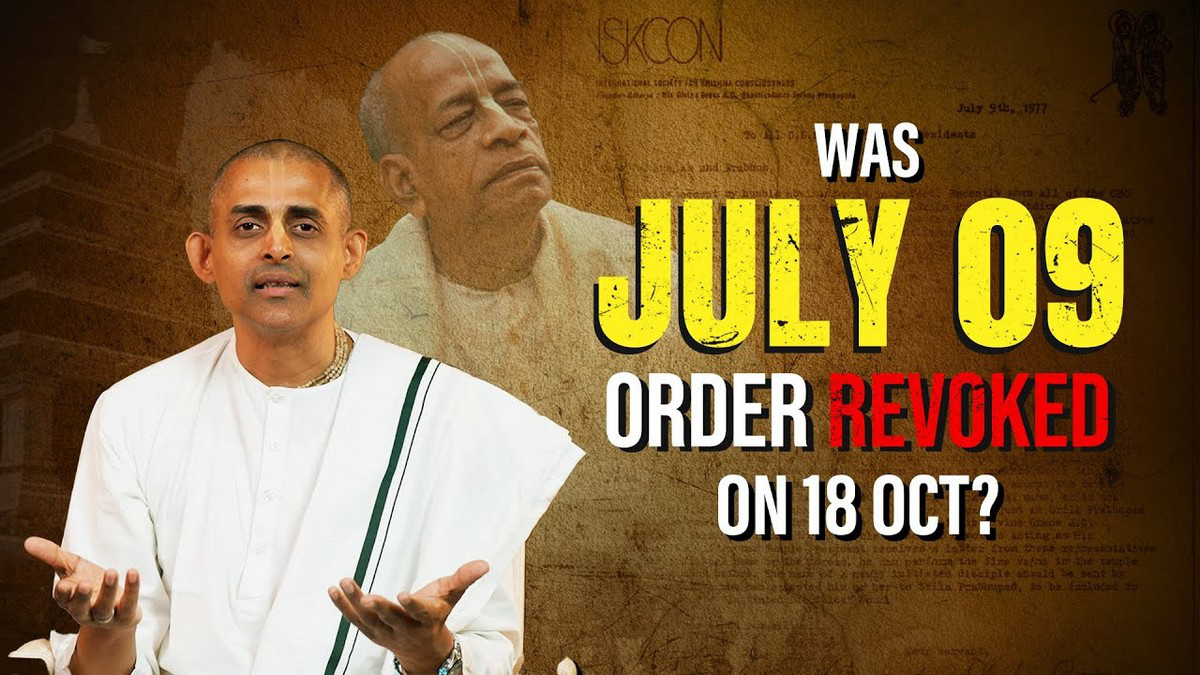
This article talks about the existence of the ritvik system and how it holds true in ISKCON. It also seeks to dispel any controversies and doubts surrounding the ritvik system. These passages below will give a detailed account of how the ritvik system came into being and its relevance.
The article also speaks about the groundbreaking July 9th directive and why ISKCON has to continue to follow it according to Srila Prabhupada’s directive.
Controversy About The Ritvik System The supporters of the self-appointed guru system have gone on proclaiming for years that the ritvik system is a temporary system. The same supporters have very loosely interpreted Srila Prabhupada’s meaning of “The disciple of my disciple is my grand disciple”.
The unauthorised gurus question the legitimacy of the ritvik system and say the Srila Prabhupada’s disciples are authorised to be gurus by him.
The Two Key Evidences Of The Ritivik System The ritvik system is based on these two key pieces of evidence which give it a very solid grounding. One evidence is May 28th 1977 GBC meeting with Srila Prabhupada and the other is the watershed July 9th 1977 directive.
The words “The disciple of my disciple is my grand disciple” comes from May 28th 1977 GBC meeting.
The Background Leading To The May 28th 1977 Meeting The GBC meeting of May 28th 1977 was responsible for shaping the ritvik system. Before this meeting came about, there was another important conversation between Srila Prabhupada and Tamala Krishna Goswami on 22nd April 1977. The topic of a ‘bona fide’ guru was discussed here.
Srila Prabhupada had told these wise words seven months before his disappearance. At that time both Tamala Krishna Goswami and Srila Prabhupada knew that no one was properly
qualified to be a guru in ISKCON.
Further into the conversation, Srila Prabhupada reiterated that it is important to be a qualified guru and not just become a rubber stamp. Being a rubber stamp will not be of any use.
Prabhupada took the example of the Gaudiya Matha to explain the sorry state of affairs there.
When Can a Person Become A Guru?
A person can become a guru if and only if he has been given proper authorisation by his guru otherwise it is not valid. If a person becomes a guru with improper authorisation then he is just a rubber stamped guru.
Srila Prabhupada Asks The GBC to Convene At Vrindavan In May 1977, Srila Prabhupada’s health was ailing so the devotees took a decision to shift Srila Prabhupada to a more salubrious place so he could recover which was Rishikesh in Uttarakhand. On 7th May 1977, Srila Prabhupada left for Rishikesh from Delhi. Prabhupada was staying in a rented place there.
On 14th May there was a fierce thunderstorm that caused a blackout, the devotees were shaken up by the intense weather that night. On May 15th Srila Prabhupada called the devotees and explicitly instructed them to have his will prepared.
On 16th May, the devotees were called again by Srila Prabhupada, at 2:30 am. Prabhupada indicated if he is going to pass away let it happen in Vrindavan. Srila Prabhupada was taken to Delhi by car immediately. Post which after an overnight stay Prabhupada was brought to Vrindavan by car from Delhi.
Prabhupada was staying at his quarters at the guest house in the Krishna-Balarama Temple.
Then on 22nd May Srila Prabhupada wanted to make plans before his disappearance so he summoned all the GBC’s to Vrindavan.
On 28th May, 18 of the 23 GBC’s reached Vrindavan and a meeting was held there. After many deliberations, the GBC asked five most pressing questions to Srila Prabhupada as to what would happen after his departure.
The 5 Pressing Questions That GBC Asked Srila Prabhupada 1. How long should the GBC members remain in office? 2. How can the GBC members who leave be replaced? 3. In Srila Prabhupada’s absence what is the procedure for first second and sannyasa initiations? 4. What is the relationship of the person who gives this initiation to the person he gives it to? 5. Is there any provision for publication of other translations of Vaishnava scriptures by the BBT after the disappearance of Srila Prabhupada?
When 5 GBC Members Put the Five Questions to Srila Prabhupada Firstly, the two important questions being number 3 and 4 which related to initiations in ISKCON were discussed. Srila Prabhupada repeatedly stressed that he would appoint ritviks who will act on his behalf and not diksha-gurus which answered question 3.
This proves that Srila Prabhupada is the sole authority of ISKCON. His directives are followed here. No other directives hold good. The ritviks would be officiating acharyas but only on Srila Prabhupada’s behalf.
Srila Prabhupada chose 11 members for the GBC who would be ritviks. This was done in the July 9th directive and that is why this directive holds immense importance. The appointment of ritviks was done as a permanent arrangement which continued to hold good even after his disappearance.
Now for question 4, the disciples asked the question in a complex manner instead of keeping it simple. They could have kept it as whose disciples are those who are getting initiated? But they asked it in a complex way and got a complex reply from Srila Prabhupada.
Prabhupada said in his presence none can become guru. He was also stating an earlier principle that one can become guru only on the basis of a guru’s order.
Satsvarupa Dasa wanted to ask about the relationship between the ritivik and the devotee. But he asked what is the relationship between the person who grants initiation and the disciple. For Srila Prabhupada, he is the sole initiator and the ritivik only acts as an officiator.
Satsvarupa Dasa and Tamala Krishna Goswami wanted to ask if the disciples were theirs or Srila Prabhupada’s. Tamala Krishna Goswami clarified the misunderstanding between Srila Prabhupada and Satsvarupa Dasa regarding the reference to the initiator and the officiator.
Now we will take a look at Srila Prabhupada’s reply, Since Tamala Krishna Goswami and others are officiators they become the disciples of the initiator i.e., Srila Prabhupada. Prabhupada was intent on one thing, one can become a guru only through his orders and post that the question of disciple arises.
Uncovering The Statement Recorded By The GBC On 28th May 1977, GBC recorded this statement in the minutes of the meeting which was supposedly said by Srila Prabhupada. They recorded “Srila Prabhupada said, he will appoint several devotees who will perform initiation in the future even after his disappearance. The disciples accept Srila Prabhupada as their spiritual master”.
But this was false, All 18 members present there signed the minutes but they did not get it signed by Srila Prabhupada which was a huge error. Srila Prabhupada’s signature had to be there as he had given the GBC ISKCON’s future roadmap in the five questions asked. But the GBC did not take his signature.
Recounting From Satsvarupa Dasa’s Memoir There was no consensus among the devotees to get the happenings in writing so that it would not be contested later. Tamala Krishna Goswami was not willing to get Srila Prabhupada’s signature on the GBC minutes which led to it being contested later.
What the GBC recorded in their minutes on 28th May 1977 will not hold ground as it does not bear Srila Prabhupada’s signature. But the July 9th directive is the ultimate doctrine because it has Prabhupada’s signature.
The system running in ISKCON with the ritviks who were later appointed diksha-gurus is false because Srila Prabhupada did not appoint any diksha-gurus but only ritviks as per the July 9th 1977 directive.
The Conformation Of The Ritvik System In Yashodanandan Swami’s memoir at the Krishna Balarama Temple courtyard, several devotees of Srila Prabhupada talked about the ritvik system. This verifies its authenticity.
Gauridasa Pandita Dasa who was Srila Prabhupada’s personal servant in 1977 confirmed hearing about the appointment of more ritviks in the future which could be done at Mayapur.
Thus, the July 9th directive reinforces that the ritviks are the disciples of Srila Prabhupada alone and no one else.
Yashodanandan Swami said Tamala Krishna Goswami had received instructions from Srila Prabhupada about sending the July 9th directive to all the temple presidents which will explain the ritvik initiation system for the future.
On 10th July, Tamala Krishna Goswami said that the directive has been signed by Srila Prabhupada and he has named eleven ritviks who can initiate on his behalf. They will be ritviks even when Prabhupada departs, it is all on tape.
HH Cyavana Swami also confirms Srila Prabhupada’s golden words on ritvik initiation system in his Facebook page on September 7th 2016 “I will continue to accept my disciples and give them my blessings even after I am no longer physically present, you may initiate on my behalf”. To that he added, I will have millions of disciples.
Srila Prabhupada Coining The Term ‘Ritvik’ According to a report from the Vaishnava News Network, Pita Prabhu said “The fact of the matter was Srila Prabhupada made himself very clear on how new devotees coming into this movement were to be accepted even after his disappearance. The word ‘ritvik’ was heard first by me through Srila Prabhupada’s Lotus mouth and His Divine Grace used the term many times during the last two weeks in Vrindavan. I remember this clearly because I didn’t know what a ritvik was.” An Outsiders Perspective On ISKCON’s Situation in 1977 BB Puri Maharaj from Sri Chaitanya Chandra Ashram had a conversation with Prabhupada in late 1977 about the ritvik system. BB Puri Maharaj thought Srila Prabhupada had appointed 11 gurus.
He felt ISKCON would have no harmony because of this. But Srila Prabhupada rightly clarified he had only appointed 11 ritviks and not gurus. Thus even from the outside it became crystal clear that Srila Prabhupada had appointed 11 ritivks and not gurus.
The July 9th Directive And Its Status At ISKCON The July 9th directive is a watershed movement in the history of ISKCON and will always be held in the highest regard. Srila Prabhupada drives the point that the July 9th directive is his final order and must be followed by ISKCON. This order also states only 11 ritviks were appointed and no order to become guru was ever given. Thus, the July 9th directive became a cornerstone and paved the way for ISKCON’s future.